
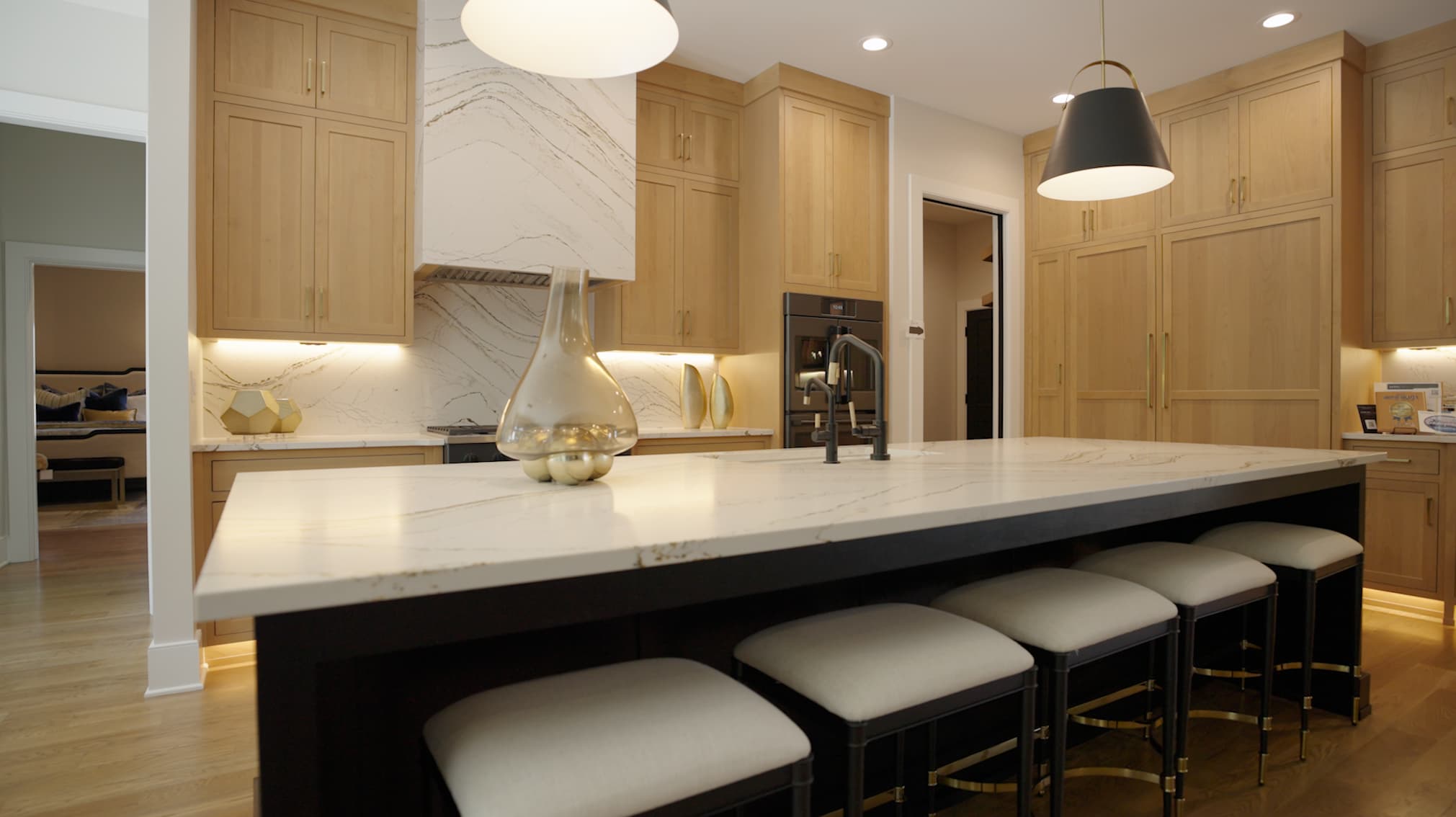
Cabinet door style sets the tone for an entire kitchen or bath. The choice between full overlay and inset is one of the first decisions that locks in your design direction—and if you’re specifying across multiple units or a full renovation, getting it right before you order saves real time and money.
Here’s a practical breakdown of both styles so you can spec with confidence.
What Full Overlay Cabinet Doors Actually Mean
Full overlay doors cover nearly the entire face frame of the cabinet box. When closed, you see very little of the frame itself—just a small reveal gap between adjacent doors and drawers.
This is the standard configuration on frameless (European-style) cabinets, but it works just as well on face-frame boxes when you want a clean, contemporary look with minimal visible wood between doors.
Why Builders Favor Full Overlay
- Faster installation. Hinge placement is more forgiving, and alignment is easier across a full run of cabinets.
- Cleaner appearance at scale. On a 20-unit build, full overlay reads consistently across different cabinet configurations without demanding tight tolerances.
- Lower material cost per opening. The door covers the frame, so you don’t need the precision fitting that inset requires.
- Wide style range. Shaker, raised panel, slab, and routed profiles all work in full overlay. This isn’t a style limited to modern aesthetics.
Full overlay is the dominant choice for production builders across Kentucky, Tennessee, Indiana, and the Southeast for good reason. It installs efficiently, looks sharp, and holds up to the demands of multi-unit residential work.
What Inset Cabinet Doors Mean
Inset doors sit inside the face frame opening, flush with the front surface of the cabinet. The gap between door and frame is tight and consistent—typically around 1/16 to 3/32 of an inch on each side.
This is a traditional American cabinetry style, common in craftsman, colonial, and high-end custom builds. It requires more precise construction at the box level and more careful door sizing.
Where Inset Makes Sense
- Custom and semi-custom builds where the client is paying for a furniture-grade look.
- Craftsman or traditional architectural styles where the face frame is part of the visual design.
- Higher-end kitchen and bath renovations where the homeowner wants something that reads as built-in furniture rather than stock cabinetry.
Inset isn’t a poor choice—it’s a different specification with different requirements. The tradeoff is tighter tolerances, more installation time, and higher sensitivity to wood movement in humid climates like Georgia or Alabama.
Side-by-Side Comparison
| Factor | Full Overlay | Inset |
| Face frame visibility | Minimal | Prominent |
| Installation tolerance | More forgiving | Tight, precise |
| Common style fit | Contemporary, transitional, shaker | Traditional, craftsman, furniture-style |
| Wood movement sensitivity | Low to moderate | Higher |
| Cost at volume | Lower | Higher |
| Best for production builds | Yes | Less common |
| Best for custom/luxury builds | Yes | Yes |
Material Considerations for Each Style
The door style you choose has a direct effect on which materials make the most sense.
Full overlay works well in MDF, thermofoil, and solid wood. MDF is a strong choice for painted finishes—it holds paint evenly and doesn’t expand and contract the way solid wood does. In climates with significant humidity swings, MDF full overlay doors give you a stable, consistent result at a price point that works for production volume.
Inset typically calls for solid wood or high-quality plywood. Because the fit is so tight, you need a material that machines cleanly and holds dimension. Solid wood inset doors in painted finishes require careful moisture management before and after installation—and that starts with properly kiln-dried lumber. Doors built from well-dried stock hold their fit far better than those made from green or inconsistently dried material.
At Cox Interior, cabinet doors are available in multiple styles and materials. The in-house sawmill and kiln drying operation in Campbellsville, KY means the wood going into your doors has been processed correctly before it ships. That’s not something you can take for granted when ordering from a national distributor sourcing from multiple mills with no visibility into the drying process.
Specifying for Your Project Type
Production Builders (10+ Units)
Full overlay is almost always the right call. You need consistency across many cabinets, efficient installation, and a look that photographs well for listings. Shaker-style full overlay in painted MDF or primed solid wood is the standard package for good reason.
If your buyer demographic skews toward higher price points, inset can work as an upgrade option on select units without changing your base spec.
Custom and Semi-Custom Builders
You’ll likely offer both. Full overlay for transitional and contemporary floor plans, inset for craftsman and traditional designs. The key is having a supplier who can handle both styles in the same order—so you’re not splitting your cabinet door sourcing across two vendors.
Remodelers and Cabinet Makers
Inset orders are more common in renovation work, especially kitchen refaces where the homeowner wants a high-end result. Full overlay shows up regularly on frameless box replacements where the client is going for a European or modern look.
Ordering and Lead Times
Lead time is a real factor in your schedule regardless of which style you’re specifying. Custom door sizing, specialty profiles, and solid wood material all add time compared to standard MDF or pre-primed stock.
The portal at portal.coxinterior.com gives you account-level access to the full cabinet door catalog—including pricing and SKU details—so you can plan your material budget before committing to a spec. If you’re working against a tight timeline or need to confirm availability on a specific style or material, call 270-818-5259 directly.
Cox Interior serves builders and contractors across Kentucky, Tennessee, Indiana, Ohio, Georgia, and Alabama. Company-owned trucking handles delivery from Campbellsville to your job site, which means fewer handoffs and more predictable arrival windows than you get from a distributor relying on third-party freight.
Making the Call
Full overlay cabinet doors are the practical default for most residential builds in 2026. They install faster, cost less per opening, and work across a wide range of design styles. Inset is the right choice when the project calls for a traditional or furniture-grade look and the budget and schedule support the tighter tolerances involved.
The decision doesn’t have to be complicated. Match the style to the architecture, the material to the climate and finish, and make sure your supplier can deliver both options reliably.
Browse the cabinet door catalog at coxinterior.com or call 270-818-5259 to discuss your project specs.
Frequently Asked Questions
What is the difference between full overlay and inset cabinet doors?
Full overlay doors cover most of the cabinet face frame, leaving only a small gap between doors. Inset doors sit inside the face frame opening, flush with the front surface. Full overlay is more common in production and contemporary builds. Inset is more common in traditional and high-end custom work.
Which cabinet door style is easier to install?
Full overlay is generally faster and easier. Hinge placement is more forgiving, and the doors don’t require the tight tolerances that inset fitting demands. For production builders working across multiple units, the time savings add up quickly.
Does wood movement affect inset cabinet doors more than full overlay?
Yes. Because inset doors fit tightly inside the frame opening, any expansion or contraction from humidity changes can cause binding or uneven gaps. Properly kiln-dried solid wood and careful finishing help manage this, but it’s a more significant concern with inset than with full overlay.
Can you use MDF for inset cabinet doors?
MDF is dimensionally stable and holds paint well, which makes it a reasonable option for inset doors in controlled environments. That said, MDF is more sensitive to moisture at the edges than solid wood, so it’s less common in inset applications where the fit is very tight and humidity may vary.
What cabinet door styles work with full overlay?
Most standard profiles work in full overlay—shaker, raised panel, flat slab, and routed designs among them. The overlay style describes how the door relates to the frame, not the visual profile of the door itself, so your design options stay wide open.
How do I order cabinet doors in both full overlay and inset styles from a single supplier?
Cox Interior carries cabinet doors in multiple styles and materials. Browse the catalog and access account pricing through the portal at portal.coxinterior.com, or call 270-818-5259 to talk through your project requirements directly.
Is full overlay or inset more expensive?
Inset cabinet doors typically cost more at volume because they require tighter manufacturing tolerances and more precise installation. Full overlay is the more cost-efficient choice for production builds. On custom or semi-custom projects, inset is often offered as a premium upgrade.